
- Indoor cycling should not cause regular knee pain. Ongoing pain usually points to user error, not a bad bike.
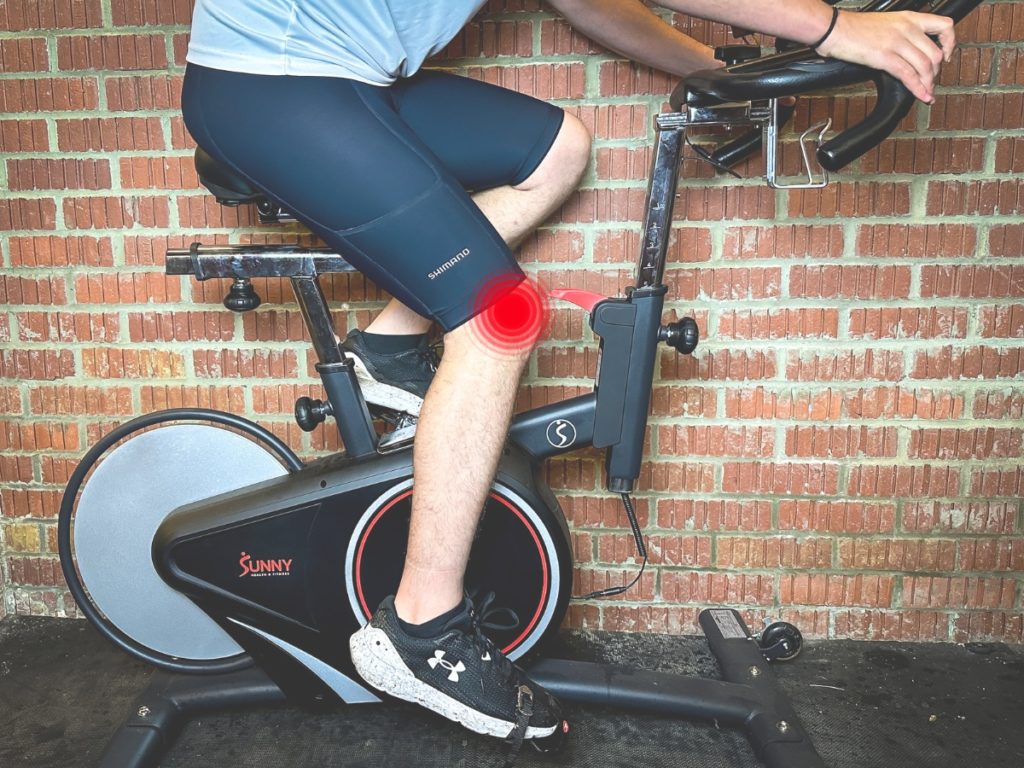
- Bike set-up is critical: wrong saddle height or fore/aft position overloads the front or back of the knee.
- Maintain solid riding form: knees track straight forward, avoid “mashing” the downstroke, and don’t sprint with either too little or too much resistance.
- Cleats are worth it. They improve alignment, help you use a full pedal stroke, and can increase power in the saddle.
- Use R.I.C.E. (Rest, Ice, Compression, Elevation) plus pain relievers or ointments to manage short-term knee flare-ups.
- Know when to back off: avoid overtraining, mix ride types, and skip jumps or intense profiles if your knees already hurt.
- See your doctor if pain becomes chronic or spreads to your hip, back, ankle, or foot, since everything in the chain is connected.
Ever taken a spin class or ridden your bike and encountered a little knee pain afterward? Read on to learn what might be causing cycling-related knee pain and how to fix it.
Are Spin Bikes Bad for Knees?
Cycling can be incredibly gentle on the knees if done correctly, as it is considered low impact. In fact, research shows that stationary cycling exercise relieves pain and improves sports function in individuals with knee osteoarthritis. However, common riding mistakes are why people experience knee pain, not the bikes themselves. For example, I have had a meniscus tear in my left knee for eight years, but I can still ride pain-free as long as my form is on point.
Just because indoor cycling is a low-impact exercise doesn’t mean that riding a spin bike will not stress your body. Exercise is all about placing stress on your body and having your body continue to adapt.
Is Knee Pain Normal After a Spinning/ Indoor Cycling Class?
Thinking knee pain is the usual aftermath of an indoor cycling class? Think again. You should not be experiencing knee pain regularly after taking your favorite spin class or enjoying a ride on your bike at home. Although it might seem easier to accept knee pain as something you must endure after a ride, it is likely that the reason for your knee pain is user error and can be avoided or diminished.
Reasons Why You Might Have Knee Pain During Indoor Cycling
How to Avoid Knee Pain When You Cycle?
- Proper Bike Set-Up: Here are a few points to consider to ensure your bike set-up is on point for a great ride. First, when your foot is at the bottom of the pedal stroke, you should have a slight bend in your knee of about 15 percent. If you cannot keep your foot flat at the bottom of the pedal stroke, this is a clear indicator that your seat is too high. The following set-up check is stopping your pedals when they are parallel to the floor. Next, focus on the foot closest to the bike’s front and check your knee position. Aim for the knee to be over the ball of your foot. If your knee is marking closer to your toes, your seat needs to move backward.
In contrast, if your knee is closer to your ankle, your saddle might need to come forward. On most cycles, the saddle can move one click forward and one-click up while keeping your knee in the same position. The same applies to the saddle, moving one click down and one click away from the handlebars. - Invest in Cleats: Cleats are worth the investment as they help with proper body alignment throughout the stroke, which helps to decrease the chance of injury. Still not convinced? Cleats also increase power output during saddle sprints by ten percent!


- Think About Your Stroke: Even as a Spinning Instructor, I will sometimes notice my form getting a little relaxed if I have taught multiple classes that day or throughout the week. Focus on making a full pedal stroke with an emphasis on knees lifting towards your chest at the top.
Illustrations of the Wrong & Correct Seat Positions
Let me break it down with some images so you can better understand the correct saddle position to minimize the risk for knee pain.
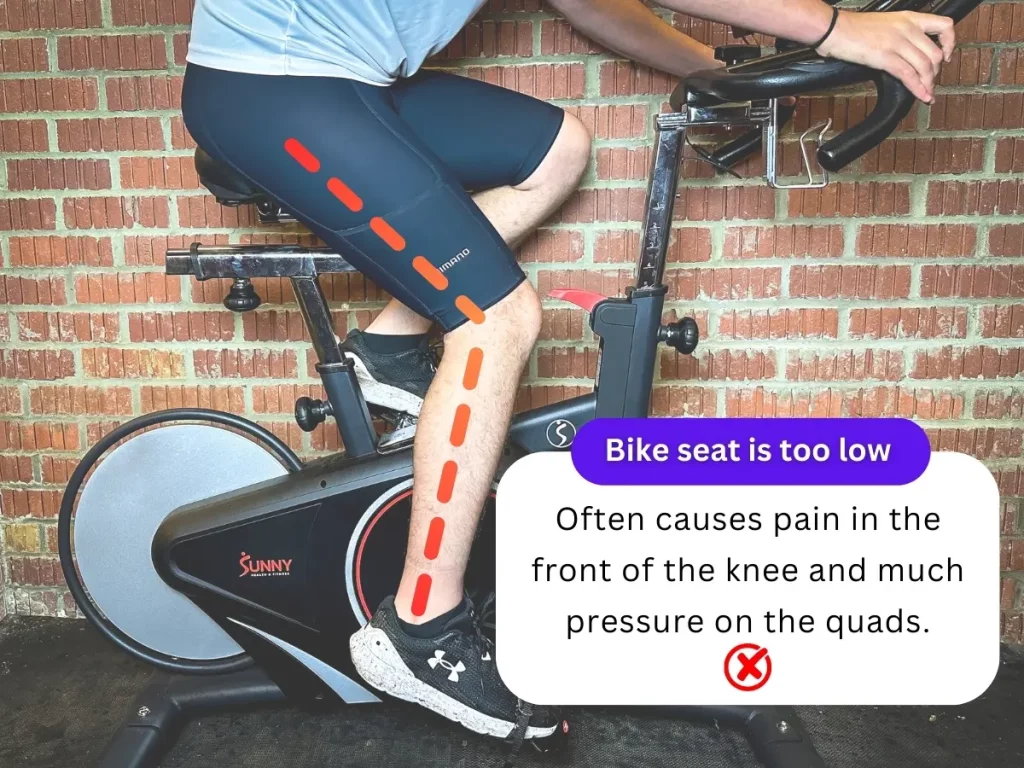
1. Low Seat: If your bike seat is too low, you’re likely experiencing pain in the front of your knee and putting excessive pressure on your quadriceps. This can hinder your cycling performance and lead to discomfort.
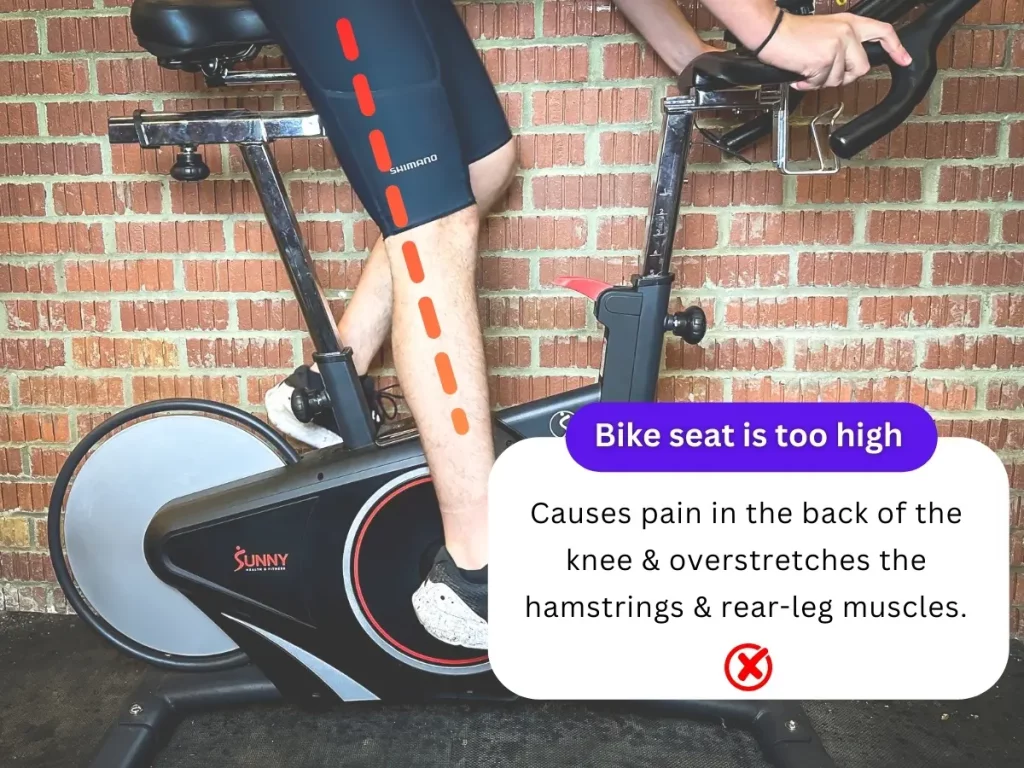
High Seat: Conversely, a seat that’s too high can cause problems at the back of your knee, as well as overstretching your hamstrings and the muscles on the rear of your legs. This not only affects your comfort but also your cycling efficiency.
Correct Saddle Height: So, what’s the sweet spot? It’s all about finding that Goldilocks zone. Aim for a saddle height that allows for a slight bend in your knee, roughly around 15 degrees. This optimal positioning ensures proper muscle engagement and minimizes strain on your joints.
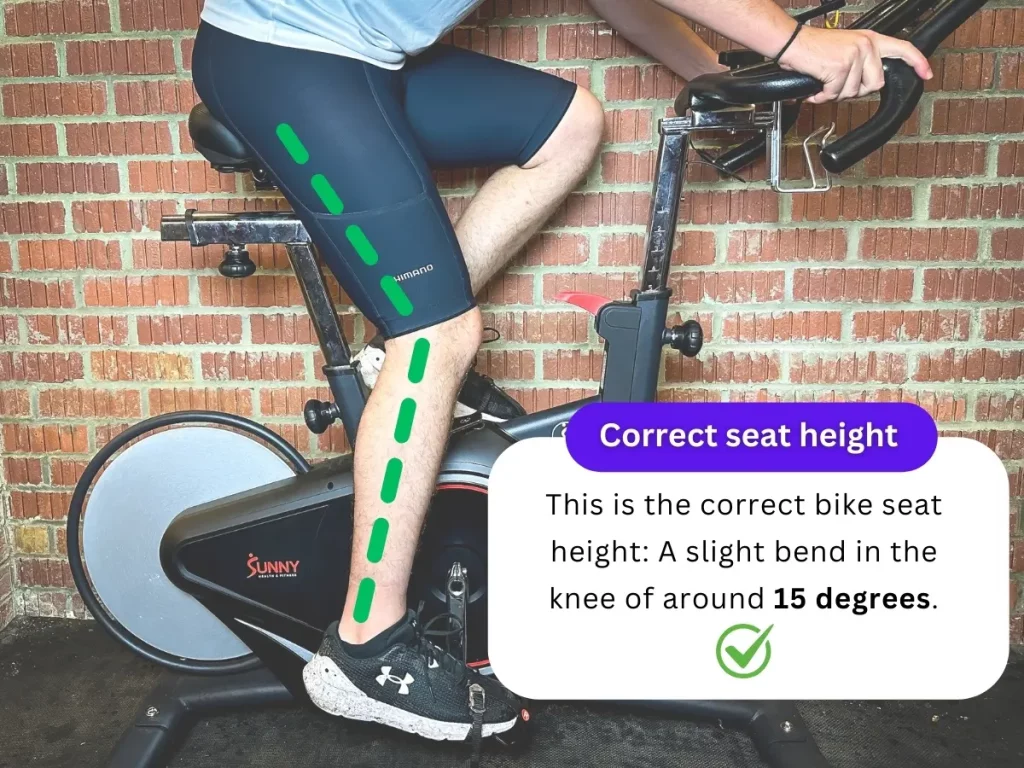
Adjusting your saddle height to this ideal level can enhance your cycling experience, prevent injuries, and ride with greater comfort and efficiency.
Remember, finding the right saddle height is critical to enjoying your time on the bike. So, take the time to make the necessary adjustments and reap the rewards of a smoother, more enjoyable ride.
How to Reduce Knee Pain After Indoor Cycling?
There are many solutions to reduce knee pain after an indoor cycling session. Here are a few remedies to try:
1. R.I.C.E
No, when we talk about R.I.C.E., we aren’t reminding you to eat whole grains (which is essential too!). Still, instead, we are referring to Rest, Ice, Compression, and Elevation, especially if your knee pain also includes swelling. So let’s break each of these components down a little further.
Important Note: R.I.C.E. is one treatment plan available. If you are experiencing pain, you should always speak with your doctor to find out the best course of action for you, as treatment options will vary from person to person.
2. Pain Relievers, Ointments, and Creams
The use of medications such as Tylenol or Ibuprofen is another option when trying to diminish post-ride knee pain. If you prefer to avoid taking a pill, many creams and ointments are also available on the market. Everyone is different, so it might take a little time to find which pain remedy works best for you. My favorite ointment to use on aching joints is BioFreeze.
3. Heat
If you are not experiencing swelling but just discomfort after a ride, heat is another option for relief. Heat therapy could come from a heating pad, hot water bottle, hot tub, or, my favorite choice, a relaxing bath. Unlike ice, this treatment should not be repeated throughout the day, and one fifteen to twenty-minute session should suffice.
4. Sports Tape
Sports tape, also known as Kinesiology Tape, is fantastic for recovery and pain relief for sore muscles and joints. There are a wide variety of brands available on the market.
5. See Your Doctor
It is vital to know when it is time to go and see your doctor. I have to admit there has been a time or two when I waited too long to go and get an injury checked out. Your knee is part of your kinetic chain. This means that it isn’t uncommon for you to begin to experience pain in your ankle, hip, or back on the same side as the injured knee as they all work as a team. Therefore, if your knee pain is becoming chronic, it might be time to go see a professional before other joints begin to bother you as well.
Other Common Indoor Cycling Injuries
Although knee pain is the most shared ailment associated with indoor cycling, there are few others to discuss. As we have explained, knee pain is most commonly due to improper bike set-up and riding form, these other common cycling injuries can often be remedied with a form check.

Thank you so very much. I am returning to SPIN after some injuries. I ‘ve noted this new trend TO just Stand UP on the BIKE. .. in these spin classes there no longer is position 1 2 3 if that makes sense. Sitting then Riding with rear over seat and resistance STANDING as though .. peddling hands on handles legs straight and standing straight UP. .. another woman stated that pressure is so bad for our knees. I do not do it. And again the Blasting music WE cannot even hear what the instructor is saying lol younger crowd… but again many many articles on hearing loss . auditory nerve. I have watched professional cyclists and Never do i ever see straight up riding and legs straight off the seat and hand on handles. .. it just does not make any sense. .. and the non stop screaming I feel like WE are on a JOURNEY to do our best. DOES a coach SCREAM and YELL nonstop to a player on the field. NEVER have i ever seen this standing up straight and all tis pressure on the knees. could you shed some light. thank you
I have had 3 surgeries on fasciitis tendons in both r and L feet.
long recovery . as a fellow athlete, you know how long it takes to recover.
I had surgeries in 2023, I am just now, past 4 months getting to feel a bit comfortable working out.
After 3 spin classes, behind both knees large bruises, pain and swelling. I mentioned to primary dr. however, and no offense, he is NOT enjoying or participating in ANY type of exercise. His response, not worries. Herd that, but never true